Pay Transparency Laws by State: Your 2026 Compliance Guide
February 13, 2026
Pay transparency laws are no longer a coastal trend. They're the new normal for hiring nationwide.
If you're posting jobs in 2026, there's a good chance you need to include salary ranges. And if you're not? You could be facing penalties that range from hundreds to tens of thousands of dollars per violation.
The landscape of pay transparency laws by state has exploded. As of 2026, 17 states plus Washington D.C. have active wage transparency laws with more jurisdictions considering legislation.
This isn't just a compliance checkbox. When done right, salary transparency becomes a competitive advantage that speeds up hiring, attracts stronger candidates, and builds trust from day one.
Here's what you need to know to stay compliant in 2026.
What Pay Transparency Laws Require
Pay transparency laws mandate that employers disclose compensation information to job candidates and current employees. While there's no federal pay transparency policy, state and local laws create three core requirements:
- Job posting disclosures: Display salary ranges in external job advertisements
- Upon-request disclosures: Provide pay information when candidates or employees ask for it
- Salary history bans: Prohibit asking applicants about past compensation
Why Do These Laws Exist?
Compensation transparency laws aim to close the gender wage gap, break the cycle of pay discrimination, and promote equitable compensation. When you post pay ranges upfront, candidates can better evaluate opportunities, negotiate effectively, and make informed career decisions.
The requirements vary significantly by state. Some apply to all employers, while others kick in at specific employee thresholds (4+, 10+, 15+, 25+, 30+, or 50+ employees depending on location). Understanding which states with pay transparency laws affect your business is the first step toward compliance.
Pay Transparency Laws by State: 2026 Overview
Here's a quick reference for states that require pay transparency in 2026:
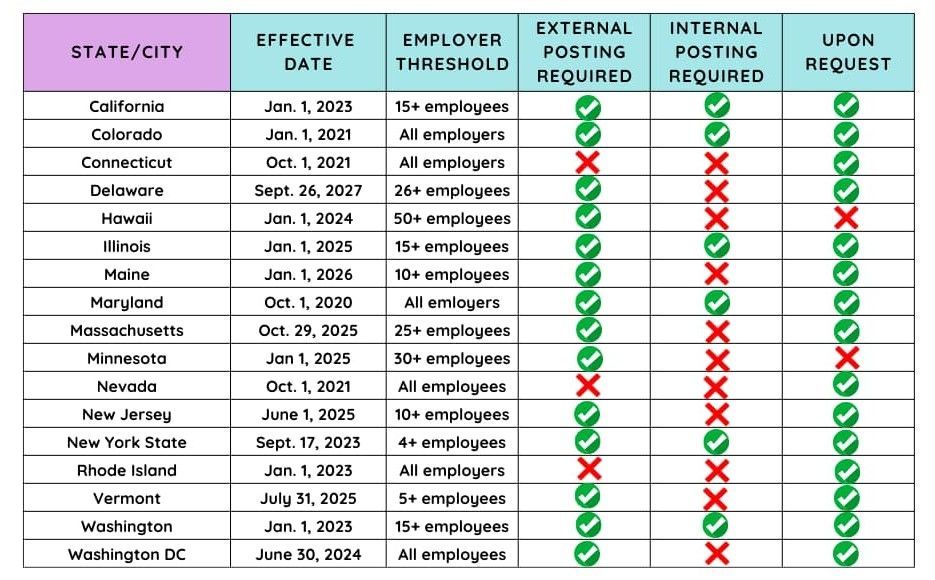
Note: Several major cities including New York City, Cincinnati, Columbus, Cleveland, Toledo, Ithaca, and Jersey City have additional local requirements.
Multi-State Compliance Strategy
Managing pay transparency laws by state across multiple locations can feel overwhelming. But there's a smarter approach than creating unique postings for every jurisdiction.
The "Highest Standard" Approach
Instead of tracking dozens of different requirements, adopt the strictest state as your baseline. Here's why this works:
- Use the strictest state as your baseline: States like Colorado, Illinois, and New York have the most comprehensive requirements. They include external AND internal posting disclosures, plus benefits descriptions.
- Create a single compliant template: One standardized job posting format that works everywhere reduces risk and administrative burden.
- Scale efficiently: As new states adopt laws, you're already covered.
This approach aligns with creating a competitive pay strategy that works across your entire organization, not just in regulated states.
What Your Job Posting Must Include
Your compliant job posting template should contain these essential elements.
- Job title and location(s): Clearly state where the work will be performed, including remote eligibility.
- Specific pay range: The range must be a good faith estimate specific to the job and location. Keep spreads to $10,000-$15,000 maximum. Avoid meaningless ranges that fail the good-faith test and create legal risk.
- Benefits summary or link: Many states require a general description of benefits and other compensation (bonuses, commissions, stock options). A link to your benefits page satisfies this requirement.
- Remote eligibility: If certain states are excluded due to compliance complexity, explicitly state that in the posting (e.g., "This remote role is not available to residents of [state list]").
- For Illinois/Colorado/New York: Include language confirming that current employees were notified of this opportunity within required timeframes.
When building your standardized template, consider how it integrates with your broader approach to make recruiting more inclusive and reflects the top skills employers look for in your industry.
Common Compliance Mistakes to Avoid
Even companies with the best intentions make predictable errors when implementing pay transparency laws. Here are the five most common traps and how to avoid them.
1. Overly Broad Ranges
Posting "$50,000-$500,000" doesn't provide meaningful information and fails the good-faith requirement in most states.
Keep spreads reasonable. Typically $10,000-$15,000 for most positions.
2. Forgetting Internal Postings
Illinois, Colorado, and New York require employee notification for promotion and transfer opportunities. Illinois has a strict 14-day rule that trips up even sophisticated HR teams.
The most common mistake? Posting externally on a Friday and forgetting to set the internal notification deadline.
3. Ignoring Remote Work Triggers
Many states assert coverage if the job could be performed in-state OR if the employee reports to an in-state supervisor.
Don't assume a "remote" label exempts you. If a candidate could work from a covered state, the law likely applies.
4. No Documentation Trail
You must be able to defend your pay ranges with documented methodology. Store these records for at least three years:
- Job postings as published
- Salary architecture and range approvals
- Market data references
- Internal notifications to employees
Without this documentation, you can't prove compliance during audits or defend against discrimination claims. Strong documentation also supports effective succession planning and helps address the skill gap in competitive markets.
5. Exceeding Posted Ranges
If you want to offer above the maximum posted range, update the posting first. Exceeding your own published range creates internal equity issues and undermines the entire purpose of transparency.
This ties directly to the cost of hiring. Fixing pay equity problems after the fact is far more expensive than getting it right upfront.
Turn Compliance into Competitive Advantage
Pay transparency laws have fundamentally changed how we hire in America. With 17 states plus DC requiring some form of wage disclosure, and more jurisdictions considering legislation, the compliance landscape will only grow more complex through 2026 and beyond.
But here's what we've learned after 65+ years in business: the companies that thrive aren't the ones simply checking compliance boxes. They're the ones who recognize that pay transparency accelerates hiring when done right.
Use the strictest state as your baseline. Build one rock-solid template that works everywhere. Keep ranges meaningful and defensible. Document everything. And watch your time-to-fill drop as candidates self-select based on clear expectations.
At Nesco Resource, we've been connecting talent with employers nationwide since 1956. From contingent labor and direct hire solutions to vendor-on-premises services and managed workforce programs, we deliver flexible, efficient, and strategic workforce solutions.
We've helped thousands of companies navigate complex employment regulations while building stronger, more equitable teams. Whether you're hiring in one state or fifty, we turn pay transparency from compliance burden into recruiting advantage.
Ready to build a staffing plan that works in today's transparent hiring environment? Contact us or refer to resources like our 2026 Employment & Compensation Guide for further research.
Frequently Asked Questions
What are pay transparency laws?
Pay transparency laws require employers to disclose compensation information to job applicants and current employees. Requirements typically include posting salary ranges in job advertisements, providing pay information upon request, and prohibiting salary history inquiries during hiring.
Which states require pay transparency in 2026?
As of 2026, 17 states plus Washington, D.C. have active pay transparency laws: California, Colorado, Connecticut, Delaware (effective Sept 2027), Hawaii, Illinois, Maine, Maryland, Massachusetts, Minnesota, Nevada, New Jersey, New York, Rhode Island, Vermont, and Washington. Several major cities also have local requirements.
Do pay transparency laws apply to remote jobs?
Yes, many states assert coverage if the job could be performed in-state or if the employee reports to an in-state supervisor. If you're hiring remote workers, assume the law applies to any state where candidates could potentially work. Some employers explicitly exclude certain states from remote eligibility to manage compliance complexity.
What is a 'good faith' salary range?
A good-faith range is one you honestly expect to pay for the position at the time of posting. It must be meaningful, not a spread so wide (like "$50,000 to $500,000") that it offers no real information. Base ranges on your salary architecture, budget, market data, and actual compensation for similar positions.
What penalties exist for non-compliance?
Penalties vary significantly by state, ranging from $100 to $20,000+ per violation. Some states allow civil penalties and private lawsuits. First violations may be waived in states like California if corrected quickly, but repeat violations carry substantial fines. Beyond financial penalties, non-compliance damages your employer brand and creates internal equity issues.
How does Nesco Resource help with pay transparency compliance?
We provide market intelligence across all 50 states, helping you establish competitive, compliant pay ranges for every position. Our team stays current on evolving pay transparency laws by state and can help you implement E-Verification and other compliance requirements. Whether you need direct hire, contingent labor, or managed workforce solutions, we ensure your hiring practices meet both legal requirements and market standards

August 18, 2026
Prevent workplace back injuries with safe lifting techniques, ergonomic tips, and simple habits that protect employees and reduce workers' compensation costs.

August 3, 2026
Learn what heat acclimatization is, why it’s vital for workers, and how proper heat acclimation training helps prevent illness and improve safety on job sites.

By Shazamme System User
•
June 19, 2026
Learn proper lifting techniques, OSHA lifting limits, and how to safely lift heavy objects with step-by-step tips to prevent workplace injury.