
May 12, 2026
How to Upskill Employees and Build a Future-Ready Workforce in 2026
The skills gap isn't a future problem. It's happening right now, on your floor, in your office, and across your industry.
The organizations that are pulling ahead aren't just hiring faster. They're investing in workforce upskilling to develop the talent they already have.
What Is Workforce Upskilling?
Workforce upskilling is the process of building new or deeper competencies within an employee's existing role to meet evolving business demands.
Deciding to upskill your employees is not about replacing people. It's about extending what they can do. It's easy to conflate upskilling workforce talent with reskilling, but they serve different purposes:
Conflating the two leads to misallocated training budgets and programs that solve the wrong problem.
Why You Can't Wait to Upskill Your Employees in 2026
The pressure to upskill your employees isn't abstract. Three specific forces are compressing your timeline:
1. AI and automation are already reshaping roles. According to Gallup's survey of Fortune 500 CHROs, 72% of chief HR officers foresee AI replacing jobs within their organizations in the next three years. Understanding the impact of AI on jobs is the first step toward responding to it strategically. The question isn't whether roles will change. It's whether your people will be ready when they do.
2. Skills have a shorter shelf life than you think. The half-life of professional skills is expected to shrink to 2.5 years. A skill learned today loses half its value by 2027. That's not a distant threat. It's the current reality driving every smart employer's workforce trends strategy right now.
3. Employees will leave if you don't invest in them. LinkedIn's Workforce Learning Report found that 94% of employees say they'd stay longer at companies that invest in their development. When you're already managing a manufacturing labor shortage and tight labor markets across skilled trades, upskilling talent is one of the most cost-effective retention levers you have.
The Real Benefits of Upskilling Employees
Productivity climbs without headcount additions. When your existing team can do more, you get more output without increasing the cost of hiring an employee.
Internal mobility becomes your talent pipeline. Upskilling workforce talent means you create more natural candidates for supervisory and leadership roles. This feeds directly into succession planning and keeps institutional knowledge inside your organization instead of walking out the door.
Your employer brand signals something real. Companies that invest in upskilling workforce talent attract better candidates. Competitive compensation matters, but workers increasingly weigh growth opportunities just as heavily.
How to Upskill Employees: A Step-by-Step Framework
Step 1: Conduct a Skills Gap Analysis
Start by getting specific about where your workforce actually stands. That means inventorying skills at the role level, not just across the org.
For example, a CNC operator whose equipment is being upgraded in 18 months has a defined, addressable gap. "We need better digital skills" does not. The more precise your starting point, the more targeted your training investment can be.
Step 2: Prioritize by Business Impact
Once you've mapped the skill gaps, rank them by urgency.
Which roles are evolving the fastest? Which skill deficits are slowing production or increasing error rates today? Which training programs have the longest ramp time and therefore need to start soonest?
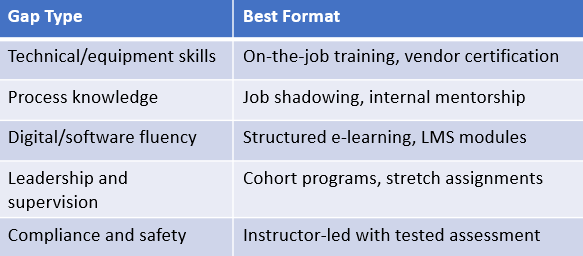
Step 3: Match the Learning Format to the Gap Type
This is where most programs go wrong. Don't apply one format to every problem.
Step 4: Build Manager Buy-In Before Launch
Most upskilling programs don't fail because the curriculum is wrong. They fail because managers never fully bought in.
Step 5: Measure Capability, Not Completion
Before the program starts, agree on what a successful outcome actually looks like in practice. Completion rates are easy to track and nearly meaningless.
The metrics that tell you whether workforce upskilling is working are things like error rate reduction or time-to-proficiency on new equipment.
If you're ready to build a formal plan around this, our guide on how to
upskill employees and build a future-ready workforce walks through the full framework. For
a step-by-step approach to doing this well, see our guide on how to build a future-ready workforce.
Upskilling vs. Reskilling: Which Does Your Workforce Need?
Reskilling and upskilling for a future-ready workforce require different diagnoses.
- If the role is evolving but not disappearing, upskill your employees. Their base experience is still relevant; you're just extending it. For example, consider a warehouse associate moving into operating an automated picking system.
- If the role is being eliminated or restructured, reskill. You're not extending existing knowledge; you're redirecting it. Example: a data entry clerk transitioning into a QA or inventory analyst role as that function automates.
Deciding between upskilling and reskilling the workforce talent in your company is the first real decision you need to make.
Where Upskilling Workforce Investment Matters Most
Not every industry feels the pressure of workforce upskilling equally. These three sectors are seeing the fastest skills evolution right now.
Light Industrial and Manufacturing
The floor-level job of five years ago looks meaningfully different today, and the pace of change isn't slowing. CNC automation, robotics integration, and digital inventory systems are raising the baseline skill requirements for roles that used to require far less technical fluency.
Skilled Trades
Tight labor markets and an aging workforce are a persistent combination across infrastructure, construction, and the trades more broadly. There simply aren't enough incoming workers to replace the experience that's retiring.
Healthcare and Administrative Support
Digital recordkeeping, compliance platforms, and telehealth tools are changing what support roles require faster than most job descriptions have been updated to reflect. Staying current also means keeping up with compliance obligations, including operating correctly as an E-Verify company as your workforce composition evolves.
Common Upskilling Mistakes Employers Make
Three mistakes that derail otherwise solid programs:
- Development gets handed off to HR instead of owned by operations. HR can design and coordinate a program to upskill employees, but if the business unit leaders aren't invested in it, the program loses priority the moment operational demands spike.
- The skills gap analysis looks backward instead of forward. It's easy to build training around problems you've already experienced. The harder and more valuable work is identifying the gaps your workforce will face 12 to 24 months from now.
- Completion rates get treated as outcomes. A learning management system showing 87% course completion is reporting activity, not progress. Define the behavioral outcome before you design the program.
The Right Partner Makes Workforce Upskilling Faster
Building a future-ready team doesn't mean going it alone.
A permanent or temp staffing agency can accelerate your strategy to upskill your employees in ways most employers haven't fully considered. Contingent staffing gives your internal teams the bandwidth to actually execute training instead of constantly backfilling vacancies.
At Nesco Resource, this is exactly what we do. Founded in 1956, we're a nationally ranked staffing and workforce solutions company dedicated to transforming lives.
We connect job seekers with opportunities that fit their skills, schedules, and goals, and we help employers find the talent they need when they need it. From contingent labor and direct hire to managed workforce programs, we deliver flexible, strategic solutions that help businesses and individuals thrive.
Frequently Asked Questions
What is the difference between upskilling and reskilling?
Upskilling builds new or deeper competencies within an employee's current role. Reskilling prepares an employee for a completely different role, typically because their existing role is being restructured or eliminated.
How do you identify skills gaps in your workforce?
Start with a skills gap analysis: inventory your current team's capabilities, compare them against what your roles require today and will require in 18 to 24 months.
What are the most in-demand skills to upskill employees in 2026?
In light industrial and manufacturing, CNC operation, robotics integration, and digital inventory systems top the list. In administrative and support roles, digital fluency, AI tool usage, and compliance literacy are increasingly essential.
How much does an employee upskilling program cost?
Costs vary widely by format and scale. On-the-job training and internal mentorship are low-cost options.
What industries need upskilling the most right now?
Light industrial, manufacturing, skilled trades, and healthcare support roles are facing the steepest skills evolution right now.
Can a staffing agency help with workforce upskilling?
Yes. A staffing partner can provide pre-screened candidates already in development programs. They can offer contract-to-hire arrangements that let you evaluate new skill sets before committing.